



We've started designing again
We've started designing again. The past year of wearing the same pieces has taught us things we didn't plan for. What the cloth does in its second winter. Which weights people reach for every single day, and which ones they save. The Kiri trouser sitting softer after the third wash. The Alba Camp shirt in Dawn pulling out of the wardrobe again when the season turned, exactly the same as the season before — not because it was new, but because it had become known.
We've found ourselves paying less attention to the season, and more to the days. To the things that hold up not because they were made for a particular month, but because they fit the way life actually moves.
That phase has done what it needed to do. This week, I started sketching again.

First, what I'm not doing
I'm not pre-selling. I'm not teasing. There is no countdown.
This isn't a moodboard reveal. There's no launch date. No new piece is finished, photographed, named, or priced. The new sketches haven't left my notebook yet. Some of them won't make it past the notebook at all — and the ones that do, the cloth will decide when they're ready.
If you came to this page looking for what's next, I'm sorry to say there's nothing concrete to show you. What's here, instead, is the start of a process. I'd rather tell you that honestly than pretend I'm closer than I am.
What the last few months were for
The instinct after a brand has lived through a season or two of the same pieces is to add. To launch. To announce. We didn't.
For the past few months we've been doing the opposite: living inside the wardrobe that already existed. The three jackets. The kimonos. The Kiri trouser. The batik dresses. The Aria shirt in Dawn, woven from tinunan by the Kanekes weavers in West Java. Each of those pieces has been in the range long enough now that the conversation around them has changed. They're not new arrivals anymore. They're what someone reaches for when it gets cold, what shows up again when it gets cold the year after, sitting a little softer each time.
Holding has been work in itself. It meant resisting the calendar. It meant trusting that the right answer to "what's next" was, for a while, the same things — worn for longer, by more people. People who bought a jacket months ago are still wearing it now, and the second wash has settled the dye, and the third wash will settle it again. That's what I needed to see.

What designing here actually looks like
There's a particular quality to the beginning of it — not excitement, quieter than that.
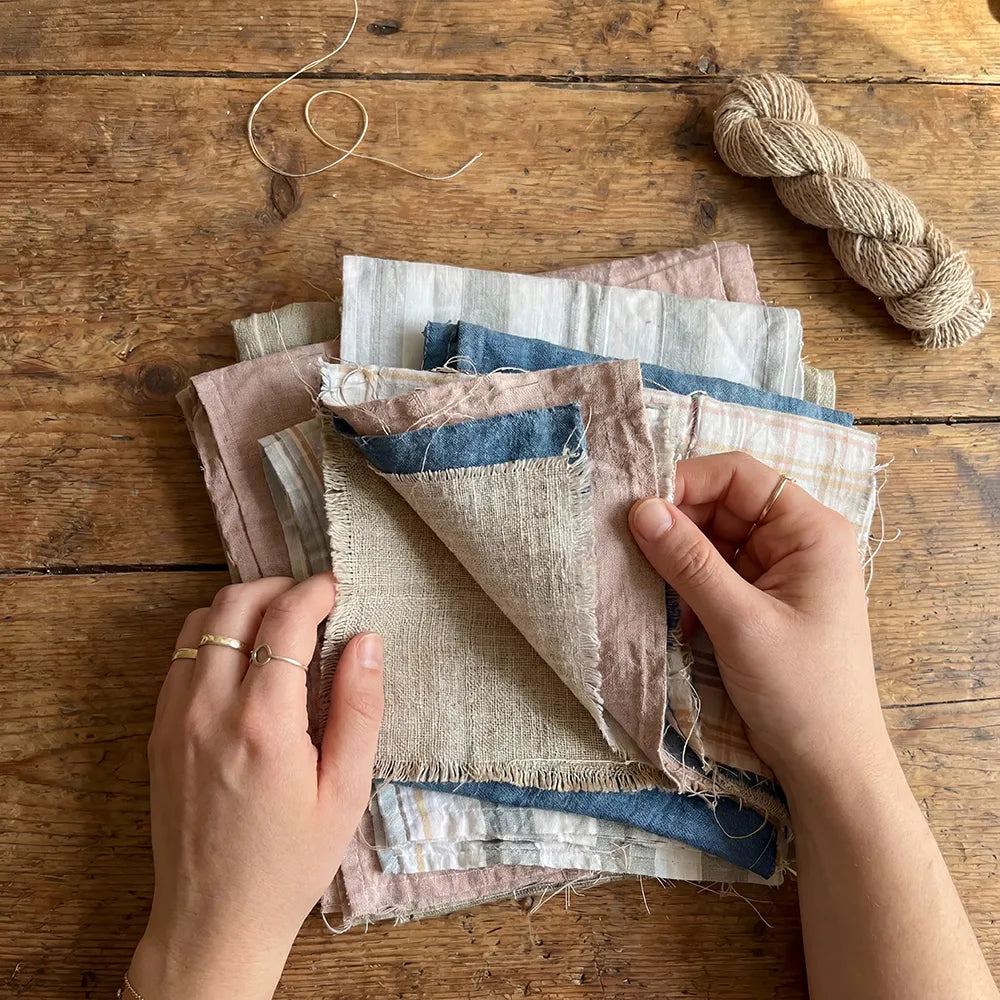
Samples on the table, a length of cloth held up to the light, set down, picked up again. The cloth has constraints, and the constraints set everything else. A Kanekes panel woven on a backstrap loom is around three metres long. Ibu Sukinah's plant-dyed cotton in Central Java has a different drape, a different palette, a different rhythm of variation. Mbak Ratmi's pedal-loom collective in Klaten produces a different cloth again.
And then there's the batik.
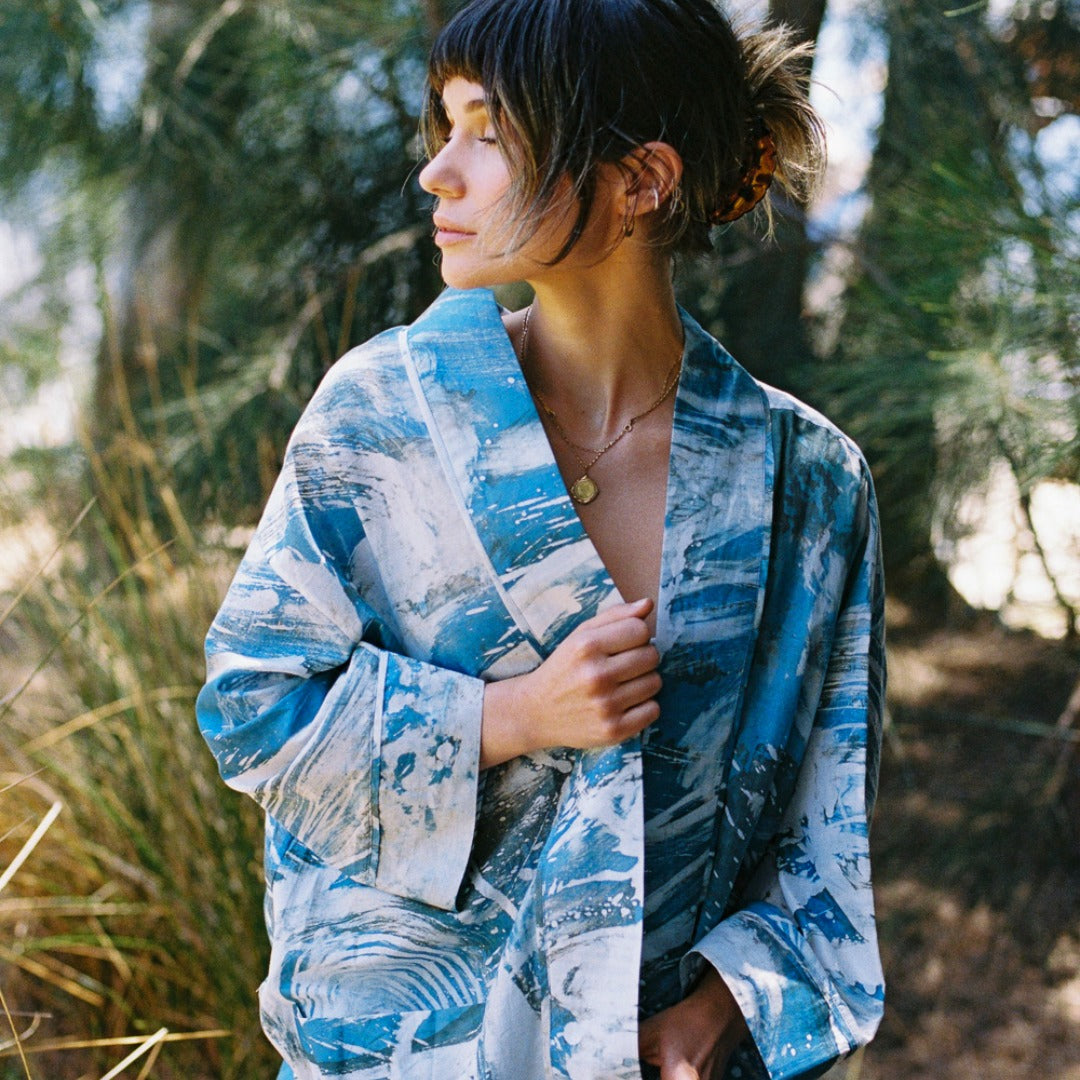
Mas Ta and his collective in Yogyakarta have been working through the monsoon season — painting and dyeing while the rain keeps everything else slow. The batik slip dresses, the kimonos, the batik shirts: all of them begin with him, drawn by hand before the cloth is ever cut. The wax lines, the resist, the dye bath — each one happens in sequence, at the pace the process allows. The dyes are plant-sourced, drawn from the same kinds of soils and materials that Ibu Sukinah works with in Central Java and that Mbak Ratmi's collective knows from Klaten. What comes out of a monsoon dye season has its own palette: deeper, more saturated in places, the humidity doing something to the absorption that a dry-season batch won't replicate. We don't correct for that. It's part of what the cloth is.
Designing at RŪPAHAUS doesn't start with a sketch. It starts with asking: which cloth, in what quantity, woven or painted over what timeline, in which season's dye palette. Sid's cultural calendar in Kanekes shapes the timing of one piece. Ibu Sukinah's dye seasons shape the palette of another. Mas Ta's monsoon batik work in Yogyakarta shapes a third. None of this moves at the pace of a fashion calendar. It happens at the rate the cloth allows.
There's one rule underneath all of it, now more consciously held: to make with as little waste as possible — and where we can, to make from what's already here rather than add something new.

What's already finished
While the rest is still taking shape, one thing is already done.
It's sitting on the studio bench. It's the first finished thing that already lives by that rule: our pure beeswax candles, rolled here by hand, one at a time — the same way the cloth is made, beginning and ending with a person.
The wax comes from small, independent beekeepers across Western Australia, from the Wheatbelt down to Pemberton and Manjimup — people who work their bees with the seasons and run pollination for local farms and orchards. It reaches us raw and unbleached, with nothing added.
Slower this time, beginning from what stays. A candle made the same way.
In the slow middle of winter, when the afternoons go dark early, it's a good thing to light.

Why now, and why slowly
Now, because the existing range can hold its own without my full attention. The pieces are doing the work of being worn. That has freed up the time and the head-space.
Slowly, because every fast thing this brand has tried hasn't worked. Meta ads only converted around sales, and we don't run sales. Wholesale economics don't add up at our current volume. The pace of the loom, the dye cycle, the weather in Klaten and the calendar in West Java — none of it speeds up because we wish it would. Design here will move at the same pace as everything else does. That isn't a slogan. It's a constraint we've stopped fighting.
I've also been honest with myself about a quieter truth: fashion demand has been softer this year, and not only for us. Some of what we've designed before may not be what we design next. The current range is not fixed. I'm holding it loosely. That doesn't mean any of the existing pieces are going away — it means I'm not assuming the next thing has to look like the last thing.
The first sketch is on paper. The cloth conversations are in motion. What that becomes, and when, is genuinely not decided yet.
What this means for you
Probably not much, in the short term — and that's the honest answer.
If you're already wearing one of our pieces, that piece is the focus. Wear it. Wash it carefully. Watch the dyes deepen. The current range stays the current range until something is genuinely ready to join it.
If you're new and you've come across us for the first time today, the place to start is what already exists. The pieces in the womenswear range are the ones we know best, and the artisans page tells you who makes them, where, and how. Read those before reading anything else of mine.
When new pieces are ready, you'll see them. There won't be a countdown. There rarely is here.
— Steph
Frequently asked questions
What does "we've started designing again" mean?
It means the design phase for new RŪPAHAUS pieces has started — not that new pieces are ready, dated, or about to launch. There is no release date. The sketches are still in the notebook. The cloth conversations with Sid in Kanekes, Ibu Sukinah in Central Java, Mas Ta's collective in Yogyakarta, and Mbak Ratmi's collective in Klaten are all in motion. That's where it is, and that's what it is.
Will there be new pieces?
There may be new pieces. Whether they arrive as a defined range depends on what the cloth allows. RŪPAHAUS doesn't release seasonal ranges to a fashion calendar; pieces arrive when they're ready. The current range — the jackets, kimonos, batik dresses, the Kiri trouser, the Aria shirt in Dawn — stays as it is until that changes.
When will the new pieces be available?
Genuinely not decided. The pace is set by the cloth — the Kanekes backstrap loom, Ibu Sukinah's seasonal dye cycle in Central Java, Mas Ta's monsoon batik work in Yogyakarta, Mbak Ratmi's pedal-loom output in Klaten. Each has its own rhythm. None of them work backwards from a launch date, and we don't push them to.
If you'd like the shorter version of this in your inbox, it's going out as the EDM on Wednesday 25 June. Otherwise, the next thing worth looking at here is what's already on the rack — or the candle, if winter's settling in.
Share:
A Father's Day Edit, Without the Countdown
How do you style handwoven pieces when you live a real life?