


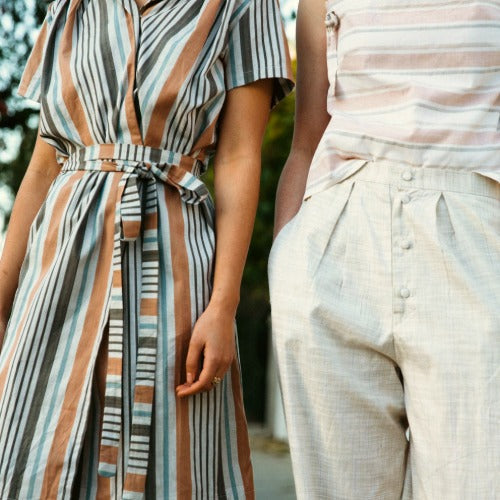
Most people own more clothing than they regularly wear — not because they need it, but because wardrobes are often shaped by seasonal marketing rather than daily life.
A practical wardrobe is built around:
• Repetition
• Climate reality
• Movement patterns
• Fibre suitability
• Tonal cohesion
If a garment cannot be worn at least 20–30 times per year, it may not belong in your real-life wardrobe.
This guide offers a structured audit to help you determine how many clothes you actually need — without minimalism, restriction, or trend-driven pressure.
For deeper philosophy, see Dressing for Real Life.
How many clothes do you actually need?
Most people function well with 15–20 core garments, including base pieces, layering items, and outerwear. The exact number depends on climate, lifestyle, and frequency of wear. A practical wardrobe focuses on repetition, versatility, and fibre comfort rather than quantity.
Why We Overestimate What We Need

Modern wardrobes are influenced by:
• Four-season retail cycles
• Trend compression
• Social media outfit turnover
• The illusion of constant novelty
But real life rarely demands constant variation.
Most people operate within predictable weekly rhythms:
Work / Errands / Social gatherings / Travel / Rest
When wardrobes are built around imagined occasions rather than lived routines, excess accumulates. A real-life wardrobe begins with observation — not aspiration.
The Real-Life Frequency Test
Before counting items, assess frequency.
The 30-Wear Test
Originally popularised in sustainability discussions, the 30-wear idea asks:
Would you realistically wear this at least 30 times?
If not, reconsider its role.
Thirty wears across one to three years is not excessive. It is baseline utility.
The 20-Style Rule
If a garment cannot be styled in at least 20 real-life scenarios — across climates and contexts — its versatility is limited.
Repetition is not boredom. It is alignment.
Learn how repetition works in seasonless clothing →
Climate Reality Audit

Your wardrobe should reflect:
• Where you live
• Average temperature shifts
• Humidity levels
• Seasonal intensity
If you live in a warm climate with mild winters, a large knitwear rotation may not reflect reality.
Breathable foundations often matter more.
Explore how natural fibres and plant dyes affect garment longevity →
Movement-Based Audit

Ask:
What does my week actually look like?
List:
• Work settings
• Commute style
• Childcare or family demands
• Travel frequency
• Social environments
Now map garments to real movement.
If pieces remain unmatched to lived activity, they may be aspirational rather than functional.
The 5-Question Wardrobe Audit Framework
Use this framework item by item:
-
Have I worn this in the past 6 months?
-
Can it adapt across temperatures?
-
Does it layer easily?
-
Is the fibre comfortable against skin?
-
Would I replace it if it disappeared?
If the answer is “no” to three or more, reconsider its place.
Emotional Attachment vs Functionality
Not all garments are purely functional.
Some hold memory.
The distinction is not emotional vs practical — it is volume.
A small number of memory pieces is natural.
A wardrobe dominated by emotional hesitation may indicate misalignment.
A real-life wardrobe is curated, not purged.
What to Keep
Keep garments that:
• Support repetition
• Suit your climate
• Layer easily
• Feel comfortable
• Integrate tonally
These become your foundation. →
Learn how repetition affects garment longevity and cost per wear →
What to Release
Release garments that:
• Require specific occasions that rarely occur
• No longer fit your movement
• Depend on trend validation
• Feel physically uncomfortable
Releasing does not require urgency.
It requires clarity.
How Many Clothes Is “Enough”?
There is no universal number.
However, most real-life wardrobes function well with:
• 5–8 daily base pieces
• 3–5 layering pieces
• 2–3 outerwear options
• 3–5 occasion-adaptable pieces
The exact number depends on climate and lifestyle.
Stability matters more than minimalism.
A Practical Example

Consider RŪPAHAUS breathable cotton dress.
Worn alone in summer.
Layered with knitwear in cooler months.
Paired with sandals or boots.
If worn 40 times per year across 3 years, that single garment delivers 120 wears.
That is real utility.
Explore our seasonless pieces designed for repetition →
Common Mistake: Confusing Minimalism with Alignment
You do not need fewer clothes.
You need the right clothes.
Minimalism reduces quantity.
Alignment reduces friction.
There is a difference.
Frequently Asked Questions
How many clothes does the average person own?
Estimates vary widely, but studies suggest many people wear only 20–30% of their wardrobe regularly.
The number itself matters less than frequency of wear.
Is decluttering necessary to build a real-life wardrobe?
Not immediately. Start with awareness and frequency mapping before removing items.
Can I keep occasion-specific pieces?
Yes — if they genuinely reflect your life and are used consistently.
Does building a smaller wardrobe save money?
Often, yes. Repetition lowers cost per wear and reduces impulse purchasing.
Closing Reflection
A real-life wardrobe is not defined by scarcity.
It is defined by coherence.
When garments reflect movement, climate, and repetition, excess becomes unnecessary.
Explore the philosophy of dressing for real life and builtind a practical wardrobe →

Share:
Why is ethical and sustainable fashion more expensive?
The True Cost Per Wear: Why Repetition Is Sustainable