



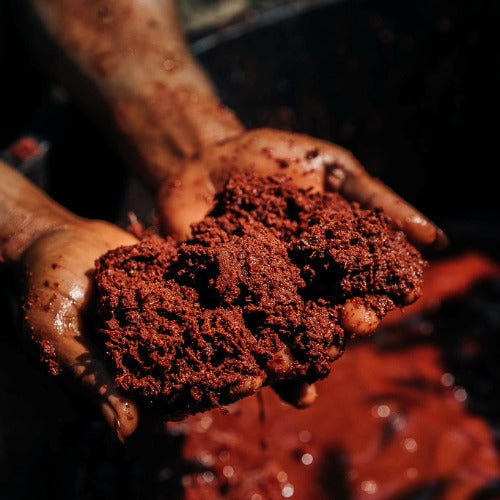
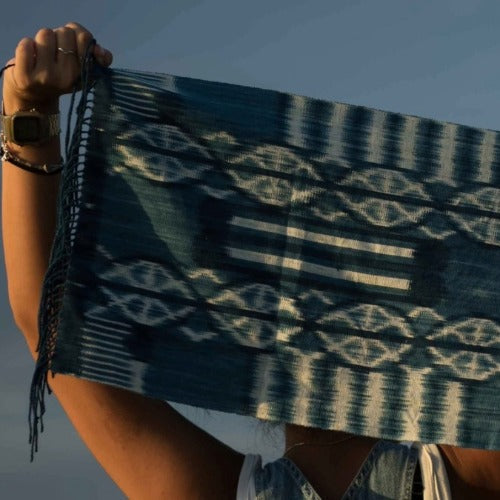
Plant dyes begin with plant matter — roots, bark, leaves, flowers — simmered or soaked until pigment releases into water. That liquid becomes the dye bath. Natural fibre goes in, absorbs the colour, and is fixed using a mordant so the pigment bonds to the thread. The result is colour that varies slightly from batch to batch, deepens with wear and washing, and softens rather than peeling away. This is how plant-dyed cloth is made, from extraction to finished fabric.
What Are Plant Dyes?
Plant dyes are pigments extracted from natural sources and used to colour fibres such as cotton, linen, and wool. Because the source is organic and the process relies on variables like water composition, temperature, and fibre behaviour, plant dye colour tends to be luminous and dimensional rather than flat.
For fibre context, see Natural Fibres & Plant Dyes.
Step 1 — Extraction
Where colour comes from

Colour begins with plant matter.
At RŪPAHAUS, the materials Ibu Sukinah works with in Central Java include Sappan wood, Mahogany bark, Water Primrose, and indigo — each producing a distinct base tone. The plant matter is simmered or soaked to release pigment into water. This extraction stage sets the base tone, but not the final outcome.
Why extraction matters
Extraction time, temperature, and plant density all change results. Longer extraction can deepen tone; shorter extraction produces softer, more translucent colour. The season matters too — the same plant, harvested at different times of year, can shift what the dye bath produces.
Step 2 — Preparing the Fibre
Plant dyes perform best on natural fibres because they absorb and hold pigment differently to synthetics.
Before dyeing, fibres are washed to remove oils or residues, then prepared to accept pigment as evenly as possible. The condition of the fibre going in affects the consistency of colour coming out.
Step 3 — Fixing the Colour (Mordanting)
A mordant is a binder that helps pigment attach more permanently to fibre.
This step influences colour depth, longevity, and tonal clarity. Not all plant dye traditions use the same mordants, and different fibre types respond differently — which is part of why plant-dyed cloth from one place rarely looks exactly like plant-dyed cloth from another.
Step 4 — The Dye Bath

Immersion and timing
Fibre is immersed in a dye bath and held for a set time. Gentle movement helps even distribution. The dye bath is often repeated to build intensity.
Why tonal variation happens

Tonal variation is normal in plant-dyed textiles because:
-
plant sources vary due to seasonal and regional differences
-
water composition differs
-
fibres absorb unevenly (especially handwoven textiles)
-
dye baths shift as pigment depletes
This is colour behaving like a natural material rather than a uniform surface.
Indigo — A Special Case
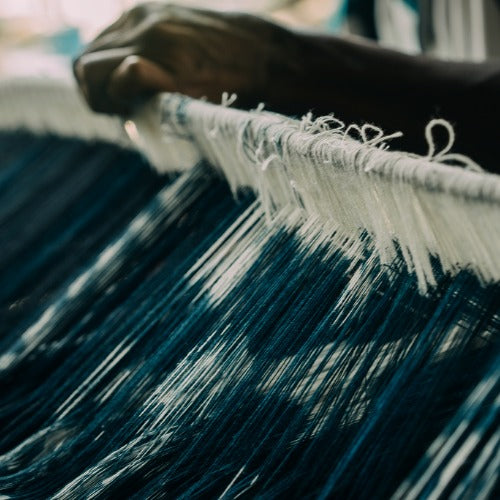
Indigo dye is unique because colour develops through oxidation rather than a typical dye bath effect. Indigo-dyed fibre appears greenish or yellowish at first. As it meets air, it oxidises and deepens into blue. Repeated dips build the tone.
Ibu Sukinah works with Indigo Tinctoria alongside the other plant sources she gathers in Central Java. She reads the season in the colour the dye bath produces — no two batches are identical, and that variation is carried through to the finished cloth.
For craft context, see Indonesian Artisan Textiles.
How Plant Dyes Age Over Time
Plant dyes tend to soften and mellow rather than peel off or collapse. Gradual tonal shifts with repeated wear and washing are not a defect — they are colour behaving like a natural material.
For care guidance, see Care Guide.
A Simple Example

A cotton garment dyed in botanical blue might:
-
read brighter at first wear
-
soften slightly after multiple washes
-
develop depth as the fibre relaxes
This is colour behaving like fibre — not like surface paint.
FAQs
Do plant dyes always fade quickly?
Not necessarily. With proper fixing and care, plant dyes age gradually — softening and mellowing rather than fading sharply. The mordanting process is the key variable: a well-mordanted plant dye on natural fibre can hold its tone through years of regular wear and washing. How you care for the cloth matters as much as how it was dyed.
Why do plant-dyed colours vary between pieces?
Because plant sources, dye baths, fibre absorption, and hand processes naturally produce variation. At RŪPAHAUS, Ibu Sukinah sources her plant materials in Central Java and reads the season in what the dye bath produces. The same plant harvested at different times of year can shift the outcome. That variation is not inconsistency — it's evidence of a process that responds to its environment.
Are plant dyes limited to muted colours?
No. Plant dyes can be soft, luminous, or richly saturated depending on fibre, mordant, and pigment. Indigo produces deep blues. Sappan wood produces warm reds and pinks. Mahogany bark produces ochres and tawny browns. The range is wider than the palette of muted tones most people associate with natural dyes.
If you'd like to see how plant-dyed cloth looks in fabric, the pieces made with plant-dyed cloth are in the range. Browse the range.
Share:
Why Handmade Objects Belong in Everyday Life
Why Variation in Handmade Textiles Is Not a Flaw