

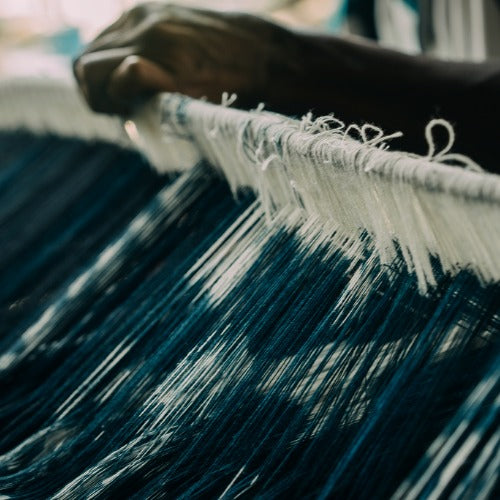
Handwoven textiles differ from industrial fabrics in three ways: how tension is applied, how long production takes, and what variation means in each system. A handwoven cloth is made on a loom where warp threads run vertically under tension and a weft thread is passed through by hand, row by row. That tension is controlled by the weaver — not by a machine — which affects how the cloth drapes, how dense it sits, how the surface feels. Industrial weaving standardises these variables for speed. Hand-weaving does not. The difference is in the cloth.
How a Loom Works

A loom holds vertical threads — the warp — under tension while horizontal threads — the weft — are woven through. In handweaving, that tension is set and adjusted by the weaver throughout the process.
Tension affects four things:
- Drape — how the cloth moves when worn
- Density — how tightly packed the threads sit
- Texture — how the surface feels against skin
- Durability — how the cloth holds under repeated wear and washing
At RŪPAHAUS, the weaving is done by Mbak Ratmi's collective in Klaten, Central Java, using pedal looms — where both hands and both feet are working simultaneously to control tension and pass the weft. Industrial looms use mechanical tension that is identical on every pass. On a pedal loom, tension shifts slightly across a session, and shifts differently between weavers. That is the structural difference between handwoven and industrially woven cloth.
Weave Density and Why It Matters
Weave density describes how tightly weft threads are packed against each other. It is one of the most direct ways a weaver shapes how a cloth behaves.
- Denser weave — more structure, more body, often more durability
- Looser weave — more airflow, softer drape, closer to the skin
This is why handwoven textiles often feel distinct from industrially woven equivalents. The density was set by a person making decisions during the making — not adjusted after finishing by a machine. The cloth carries those decisions in its structure.
Batik as a Related Handwoven Tradition
Batik is a resist-dyeing process applied to woven cloth — most commonly handwoven cotton or silk. In Java, where much of RŪPAHAUS's cloth originates, batik and handweaving are closely linked traditions. The cloth is woven first; the pattern is applied after, using wax as a resist before dyeing.
Understanding handwoven cloth is useful for understanding batik because the base cloth matters. A looser weave absorbs wax and dye differently than a denser one. The texture of the finished batik piece reflects both the weave and the dye process — they are not separable.
For more on Indonesian textiles, see Indonesian Artisan Textiles.
Time Investment Is Built Into the Cloth

Handweaving is time-based work. A single length of cloth may take days or weeks, depending on technique and pattern complexity. That time shows in the finished textile as:
- Depth of texture — the surface has dimension, not flatness
- Subtle irregularity — no two passes are mechanically identical
- Dimensional patterning — where pattern is woven in, not printed on
This is distinct from industrially produced fabric, where speed is the organising logic and uniformity is the output.
For partnership context, see (Indonesian Artisan Textiles – /pages/indonesian-artisan-textiles).
Why Variation Happens

Variation in handwoven cloth is not a quality failure. It is a consequence of how the cloth was made.
Common sources:
- Slight shifts in hand tension across a weaving session
- Fibre thickness variation within a single yarn
- Dye batch differences — particularly with plant dyes, where no two batches are identical
- Pattern alignment by hand rather than by mechanical register
The plant dyeing for RŪPAHAUS pieces is done by Ibu Sukinah in Central Java. She sources plant materials herself — bark, roots, leaves — and the dye bath shifts as pigment depletes. Two pieces dyed from the same plant source on different days will not match exactly. That variability is not an error in the process. It is what handmade cloth actually is.
In industrial systems, variation is removed. In craft systems, variation is a record of the process. The cloth holds the evidence of how it was made.
Small-Batch Production and Why It Matters
Small-batch weaving means fewer pieces produced per run — not for scarcity signalling, but because the process does not scale the way industrial production does. A weaver can only work as fast as a pedal loom and two hands allow.
The practical outcome is textiles that are:
- Less disposable — made slowly enough that quality is built in, not added at the end
- More characterful — each run carries slight differences from the last
- Designed for longer wear — the structure holds because the density was set by hand
This connects to how RŪPAHAUS thinks about production: fewer pieces, made with more attention, expected to last. For more on longevity and wear, see Seasonless Clothing.
A Practical Comparison
Industrial fabric is consistent. Predictable drape, flat surface, identical colour across the run. That consistency has value for certain uses.
Handwoven fabric is variable. Dimensional surface, weight that moves with the body, colour that deepens with wear. Neither is inherently better. They are made differently, for different purposes.
RŪPAHAUS uses hand processes where they produce something the cloth could not be without them: texture that holds, colour that ages, structure that reflects the person who made it.
FAQs
Does handwoven mean the fabric will be fragile?
Not necessarily. Durability in handwoven cloth depends on fibre type, weave density, and how the cloth is cared for. A dense handwoven cotton — like the cloth woven by Mbak Ratmi's collective in Klaten — can be very durable. The factor is structure, not origin.
Why does my handwoven garment look slightly different from photos?
Because variation occurs naturally in hand processes and plant dyes. Ibu Sukinah's dye batches shift as plant pigment depletes — no two pieces dyed at different times will be identical. The piece you receive is within the range of the cloth, not outside it.
Are handwoven textiles always more ethical?
Not automatically. Ethics depends on partnership structure and working conditions — not on the production method. See Ethics & Sustainability for how RŪPAHAUS approaches this.
Can I wash handwoven textiles normally?
Wash in cool to lukewarm water — 30°C or below. For plant-dyed cloth, cool water slows tonal shift. Avoid detergents with optical brighteners, which strip plant pigment over time. Turn inside out before washing.
If you'd like to see how handwoven cloth behaves across different weights and weaves, the current pieces include both denser and more open structures — the difference is visible in how they sit.

Share:
Why Variation in Handmade Textiles Is Not a Flaw
Natural Fabric Clothing and the Cost Per Wear Case