

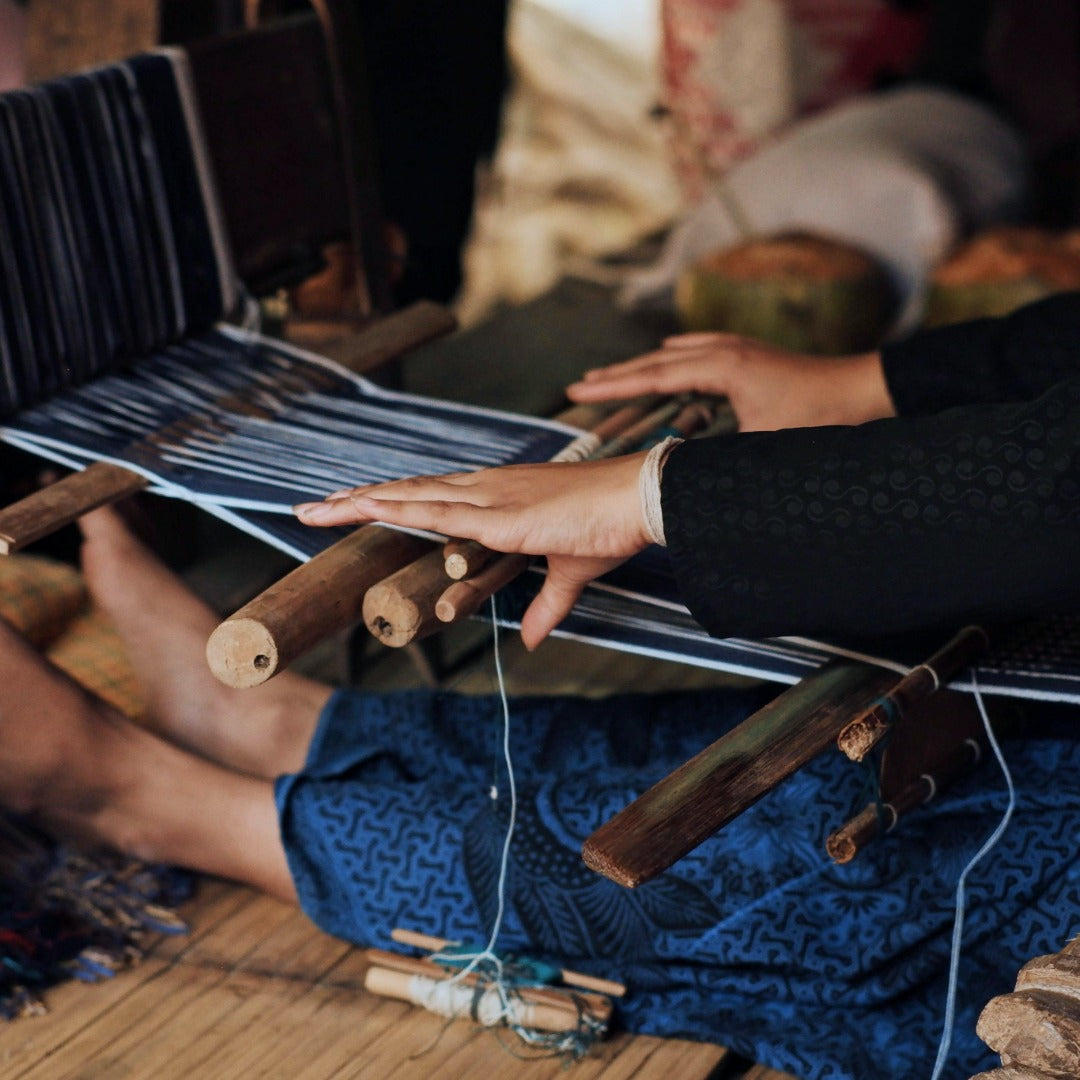
Kanekes cloth is handwoven tinunan from the forested hills of West Java. It is made on a backstrap loom — a portable loom that uses the weaver's body to hold the warp under tension — in panels of around three metres. The cloth is narrower than what a pedal loom produces, because the width is set by the reach of the weaver's arms. Plant dyes give it colour. No two runs come out the same. The Aria shirt at RŪPAHAUS is cut from one of these panels.

The backstrap loom, and why the cloth is narrow
A backstrap loom has no frame. The warp threads run from a fixed point — a post, a beam, or a tree — to a strap that loops behind the weaver's back. When she leans away, the threads tighten. When she leans in, they slacken. Tension is held by the body, not the machine. This is why the loom can be carried, packed away, set up again the next morning.
It is also why the cloth is narrow. The weft thread is passed by hand, across a width set by the reach of the weaver's arms. There is no mechanical advantage. A pedal loom in Central Java produces cloth at twice or three times that width because the shed is opened by foot and the shuttle thrown across the warp at speed. The Kanekes weavers do not use that loom. They use the one their hands and their bodies tension.
The result is a panel of around three metres, narrower than a metre across. Each panel is one weaving — a single run from start to finish, made by one person on one loom. When that panel comes off, the work for that piece is done. There is no second copy of it.
Pattern-making works backwards from this. The cloth comes first; the cut answers to it. Where the side seam falls, how the sleeve is set, where a join is needed — those are decisions made around the panel width, not against it. This is why our pieces in Kanekes cloth — the Aria shirt and what comes after it — sit the way they do.

Four plant sources, four colours
Kanekes cloth is dyed with five plant materials. Each gives a different colour, and each colour shifts depending on the season the dye was prepared in.
Black begins with reurang — rambutan skin. The cloth is dyed in the reurang bath first, then given a final dip in mud. The mud carries iron, which reacts with the tannins in the reurang skin and pulls the colour into a deep, settled black. The Aria shirt in Dawn is made from this cloth.
Blue comes from Indigofera Tinctoria — the indigo plant. The cloth is dipped repeatedly in the fermented vat, each dip deepening the colour. The final step is a dip in lime juice, which deposits residual kapur into the fibre. It is this last step that settles the blue and gives it the quality it holds.
Brown is made from mahogany bark. The bark is simmered in water and the cloth is steeped in the resulting bath. The final dip is in lime water — air kapur — which shifts and fixes the colour into the warm brown the finished cloth carries.
Yellow comes from tegeran wood or jackfruit heartwood — kayu tegeran or kayu nangka. The two give slightly different yellows. Which one is used depends on what is available to the weaver that season.
These are not stable, repeatable industrial colours. They depend on what the plants gave that season, how the water sat in the vat, what the weather did to the cloth on the drying line. A run dyed in March will not match a run dyed in September. Every dye source used for Kanekes cloth — and every other dye source we work with — is listed in our colour glossary, which is the place to go if you want to see what's currently in production.

Sid, and how the work moves
Sid works in outer Kanekes. He is the liaison between RŪPAHAUS and the weavers — translator, scheduler, and keeper of the cultural calendar that decides when work happens and when it doesn't.
The Kanekes weavers live and work in the forested hills of West Java. The community holds its own protocols around when looms are set up, when dye is prepared, when finished cloth is released. These protocols are not always aligned with our shipping schedule. There are weeks when nothing comes off the loom, and weeks when several panels arrive together. Sid is the person who tells us what is happening and why, and who carries the order back in the language and in the way the community expects to receive it.
This means our timelines are not standard. When a piece is in stock, it is in stock because a panel was woven, dyed, finished, and sent. When it sells out, the next run is on the loom — or it isn't yet, because the calendar said something else mattered first. We do not push.
The pace belongs to the loom, and to the season the loom is in. Our part is to plan around that, not against it. If you'd like to read more about who we work with — including Ibu Sukinah in Central Java and Mbak Ratmi's pedal-loom collective in Klaten — our artisan partners page is where their work is set out.

What the cloth does when you wear it
The Aria shirt is cut from a Kanekes panel. The version in Dawn carries Indigofera Tinctoria, mud, and Beleric fruit — the cool blue-grey described earlier in this post, the one that reads slightly different in raking light than under a lamp.
Plant-dyed cloth deepens with wear. Each wash settles the dye further into the fibre, and the colour tightens. The shirt you receive will not be identical to the shirt in the photo, and the shirt in six months will not be identical to the shirt today. The hand of the cloth — the way it falls, the slight irregularities along the warp — is the loom and the weaver showing through. Lay a palm against the cloth and the tension shifts are there to feel: where she pulled tighter, where she let it slacken. That is not a flaw. That is what tells you the cloth was made by a body, on a loom, in a place.
For care — how to wash, how to dry, what to expect over the long arc — the natural fibres and plant dyes guide covers what to do and what to leave alone.
FAQs
What is Kanekes cloth?
Kanekes cloth is handwoven tinunan made by weavers in the forested hills of West Java, on a backstrap loom that uses the weaver's body to tension the warp. It is woven in panels of around three metres and plant-dyed in small batches. Each panel is the record of the season it was made in.
What is a backstrap loom?
A backstrap loom is a body-tensioned loom. The warp threads run from a fixed point — a post, a beam, or a tree — to a strap that loops behind the weaver's back. The weaver leans back to tighten the warp and forward to release it. Because the loom has no frame, the cloth's width is set by the reach of the weaver's arms, which is why backstrap-woven cloth is narrower than cloth from a pedal loom.
What does tinunan mean?
Tinunan is the local Sundanese term for woven cloth. In the context of the Kanekes weavers, it refers specifically to the handwoven panels made on the backstrap loom in the forested hills of West Java.
Why are no two pieces of Kanekes cloth identical?
Plant dyes shift with the season. Turmeric, jackfruit heartwood, Indigofera Tinctoria, Sappan wood, mud and Beleric fruit each give a different colour, and each colour responds to the water, the weather, and the time the dye was prepared in. The cloth is also woven by hand at body tension, so the weft is not perfectly even. The variation is the record of how that panel was made — not a defect to correct against.
How is Kanekes cloth different from cloth woven in Central Java?
The looms are different. Central Javanese weavers — including Mbak Ratmi's collective in Klaten — use pedal looms, which produce wider cloth at a faster rate. The Kanekes weavers use backstrap looms, which produce narrower panels at the pace of the body. The two cloths feel different in the hand, and they sit differently when made into a garment.
The Aria shirt is the first piece RŪPAHAUS has cut from Kanekes cloth. If you want to feel the difference between a backstrap-woven panel and a pedal-loom cloth in person, the Aria shirt page shows the colourways currently in stock. The next run of Kanekes cloth is on the loom when Sid says it is.

Share:
Natural Fabric Clothing and the Cost Per Wear Case
Why does handwoven cloth have knots?