

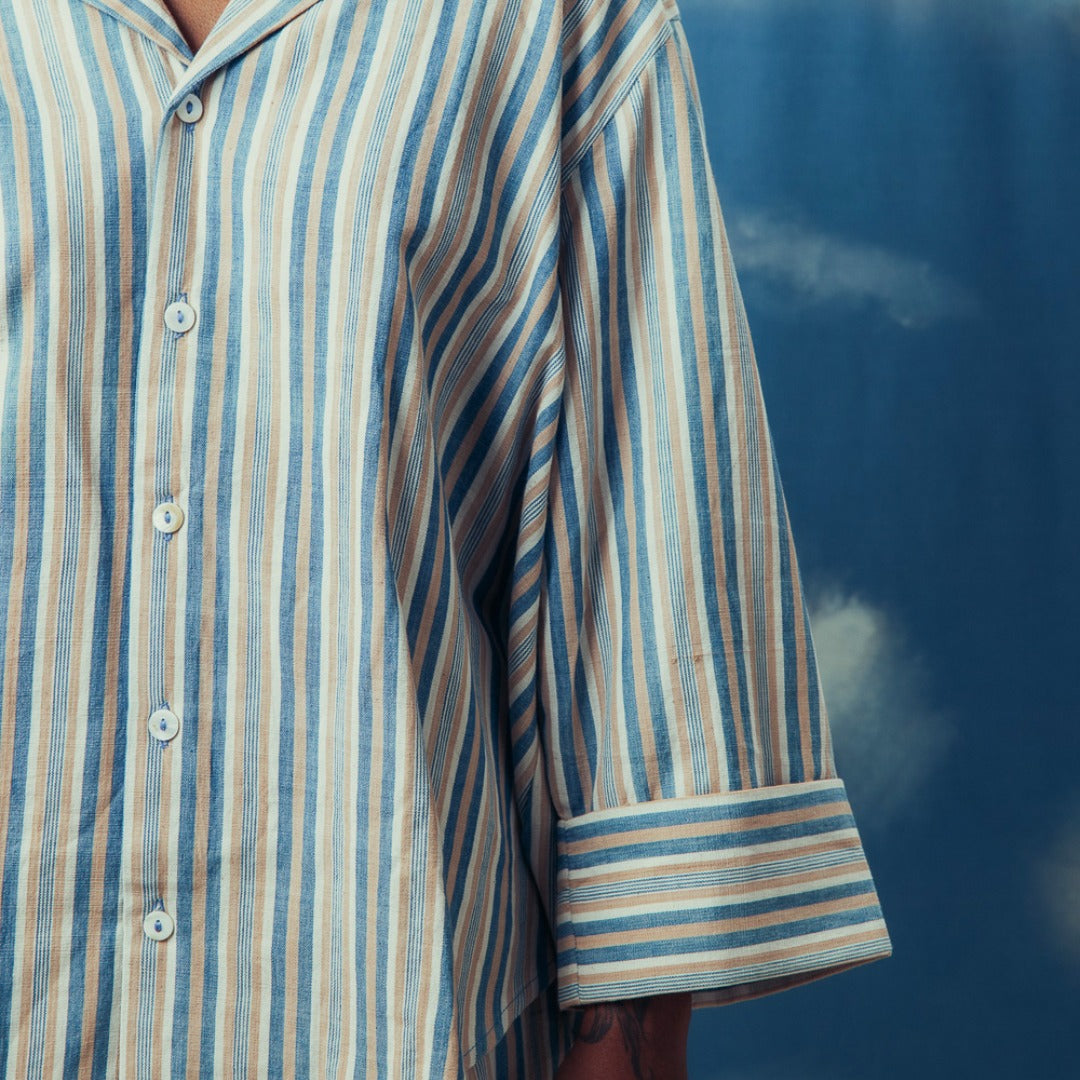
Handwoven cloth has knots because, somewhere in the weaving, a thread ran out or broke, and the weaver tied a new length on by hand and kept going. The small bump you can feel on the surface is that join. It is not a fault in the cloth or a step someone missed.
It is the point where a person solved a problem mid-weave, the only way the cloth could carry on being made.
On a backstrap or pedal loom, threads break. A knot is what that looks like afterwards.
What a knot in handwoven fabric actually is

Thread is not infinite. A weft length gets used up, or a fibre gives way under tension, and the weaving stops until it is fixed. The weaver ties the broken end to a fresh length, trims the tails, and carries the weft on across the warp. That tie is the knot. It sits where the break happened, which is why knots fall at no fixed interval — they appear wherever the thread decided to end.
Run a finger slowly across a handwoven panel and you can find them: a slight catch, a small density in the weave, here and not there. In a machine-made cloth you will not find them, because the process is built to eliminate exactly this.
Why a machine doesn't leave knots

Handweaving keeps that moment. At Mbak Ratmi's pedal-loom collective in Klaten, Central Java, the weft is thrown by hand and the tension held by the weaver's own rhythm at the treadles. In the Kendeng mountains of West Java, the Kanekes weavers work on backstrap looms, where the warp is tensioned by the weaver leaning back against a strap. Different looms, same truth: when a thread breaks, a person ties it, and the cloth remembers. Meet the weavers we work with.
This is also why no two handwoven panels are identical. The breaks fall in different places. The tension shifts a little as a body tires and resettles across a session. The cloth carries the particular history of the hours it took to make.
Knots, tension, and the surface you can feel
The knot is the clearest mark of handweaving, but run your hand across a whole panel and you will feel more than the join.The tension changes across the cloth — a little firmer in one stretch, a little softer in another. On a backstrap loom that tension is held by the weaver's posture, and a body settles and shifts over the hours of a single panel. On a pedal loom it is held by the weaver's rhythm at the treadles. Either way it is a person, not a constant machine pull, so the weave packs slightly differently from one section to the next.
That is also why a handwoven surface catches light the way it does. Each weft row sits at a marginally different angle from the last, so the cloth has a faint, irregular grain instead of a flat, uniform face. Hold it to a window and the surface reads as alive rather than printed. The knot is the part you can name; the tension and the grain are the part you feel before you have words for it.
Is a knot a flaw, or not?

It helps to know what to expect before the piece arrives, so the small irregularities read as what they are. The knot will not unravel; it was tied to hold. It will not work loose in the wash. Over time the cloth settles around it, and the join becomes part of the surface rather than something sitting on top of it.
What you are feeling, when your hand catches slightly, is the difference between cloth made by a machine and cloth made by a person at a loom.
FAQs
Why does handwoven fabric have knots or small bumps?
Because a thread broke or ran out during weaving and the weaver tied on a new length by hand to continue. The knot is that join. It happens on both backstrap and pedal looms and is a normal part of weaving cloth by hand.
Are knots in handwoven cloth a defect?
No. A knot is a repaired thread join, tied to hold and trimmed close. A defect is a hole, a stain, or a dropped warp thread. A knot is none of those — it is evidence the cloth was woven by a person, not a machine.
Will the knots come undone when I wash the piece?
No. The knot is tied to stay, and washing settles the cloth around it rather than working it loose. With cool washing and gentle drying, the join becomes part of the surface over time.
Does a knot mean the cloth is lower quality?
No. Knots appear in handwoven cloth precisely because it is made by hand at the loom. The absence of knots is what tells you a power loom made the cloth, not that it is finer.
If you would like to feel the difference a knot marks, the handwoven cotton in the womenswear pieces carries it on the surface — small, deliberate, easy to find once you know what you are touching. We wrote about the weavers themselves, and the looms these knots come from, in the journal too.

Share:
Kanekes cloth: tinunan and the backstrap loom of West Java
Who are the Kanekes weavers?