

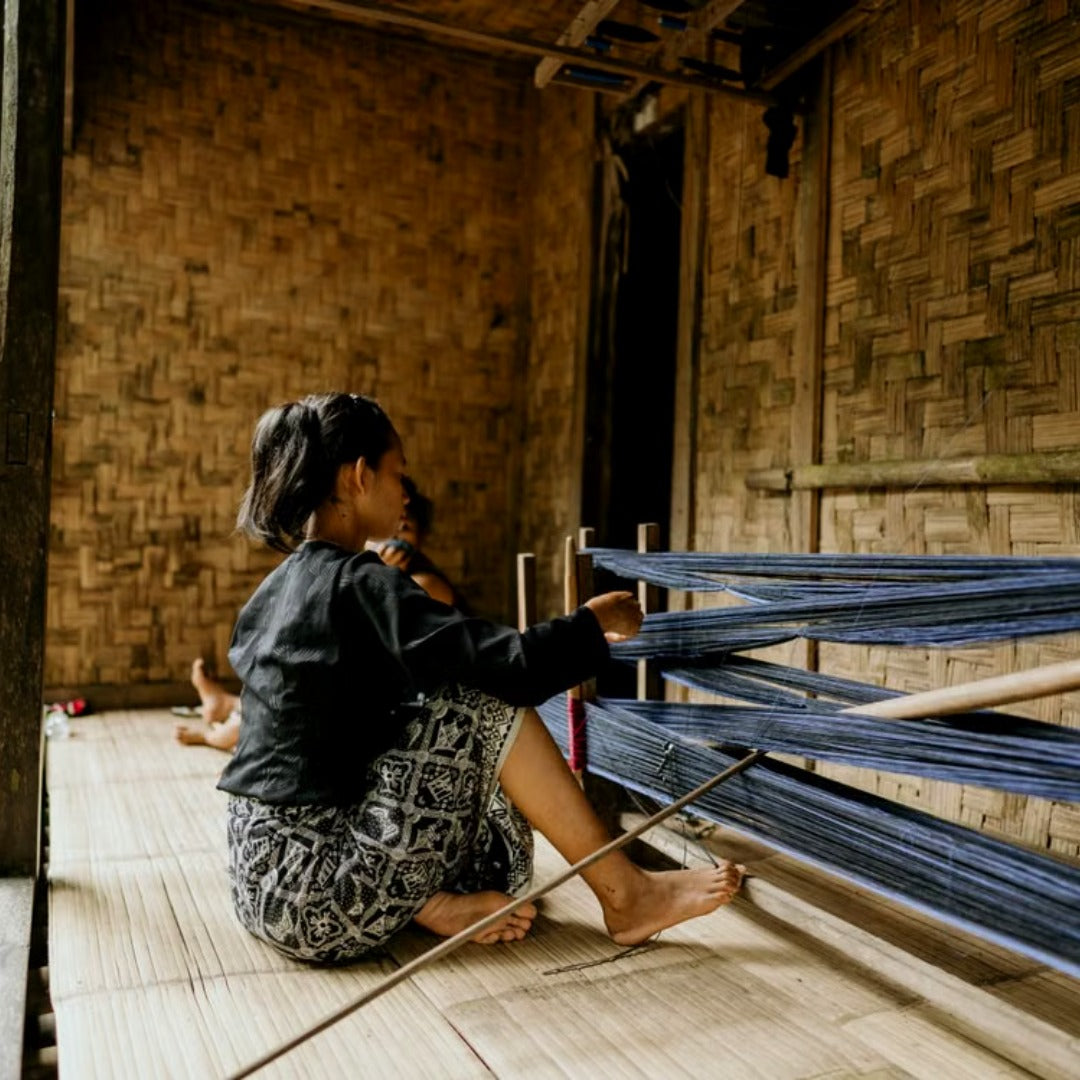
The Kanekes weavers of West Java make cloth on backstrap looms, by hand, under a set of inherited rules that govern what they use and how they live. They are an Indigenous community in the Kendeng mountains, often known as the Baduy. The rules — called pikukuh — decide the materials, the tools, and how much contact the community keeps with the outside world. The cloth follows from that: cotton grown and spun without machines, plant dyes rather than synthetic ones, nothing in the process that cannot be held in a human hand.
What the rules are, and what they shape

The community is usually described in two parts. The Inner Baduy keep the strictest observance — no electricity, no motor vehicles, no synthetic materials — and almost no contact with outsiders. The Outer Baduy keep the same core rules with a little more contact permitted at the edges. Between them, the population sits at roughly twenty-six thousand people.
These rules are the reason the cloth is what it is. A loom with no motor. Thread with no synthetic blend. Colour that comes only from plants. The constraint is not added to the cloth for effect — it is the condition the cloth is made under.
What backstrap loom weaving is

A backstrap loom is the simplest loom there is, and the most demanding of the body. Two sticks, the warp threads, and the weaver.
One end of the warp is tied to a fixed point — a post, a beam, a doorframe. The other end loops around a strap behind the weaver's lower back. Tension is held entirely by posture: lean back and the warp tightens, lean in and it eases. Every weft thread is passed and beaten in by hand. There is no frame holding the cloth square and no mechanism setting the pace.
The width of the cloth is set by the reach of the weaver's arms, so a backstrap panel is narrower than anything from a pedal loom, and it runs to about three metres before the weaving is done. Because two people never hold tension identically, and one person never holds it identically twice, no two panels come off the loom the same.
Sid, the one who moves between two worlds

There are seasons when the community turns inward — harvest, and the ritual periods that ask for the village's full attention — and in those weeks contact stops. We cannot place an order, chase a panel, or move a date.
We wait until the calendar opens again. This is why we can only work with the Kanekes for part of the year, and why we plan a full season ahead rather than to a shipping deadline. The pace belongs to the community, not to us.
Where the colour comes from

None of these are stable, repeatable industrial colours. The shade depends on what the plants gave that season, the mineral content of the water, and what the weather did to the cloth on the drying line. A run dyed in March will not match a run dyed in September. That is why the scent of the dye plants is sometimes still faintly in the fibre when a piece first arrives.
What the cloth is
The cotton is grown and processed without synthetic input, and the plant colour described above shifts from one batch to the next — a dye bath is never mixed twice the same, and the season it was prepared in shows in the result.
When a piece arrives, it carries all of that at once. The faint scent of the dye plants is still in the fibre. The colour is particular to its batch. And the surface holds the small evidence of the weaving — the places where the tension shifted, the knot where a thread broke and Sid or a weaver tied it on and continued. Held against cloth from a pedal loom, it sits and falls differently in the hand.
Why we tell you this
"Handwoven in Indonesia" is a label that tells you almost nothing. It does not tell you the weaver lives under rules older than the country named on the label. It does not tell you that the bump you can feel is a repaired break, or that the colour will never be reproduced exactly again. The cloth is the story. Our work is to keep it accurate, and to plan our year around the community that makes it rather than asking the community to plan around us.
Frequently Asked Questions | FAQs
Who are the Kanekes weavers?
The Kanekes are an Indigenous community in the Kendeng mountains of West Java, often known as the Baduy, numbering around twenty-six thousand people. They weave cotton cloth on backstrap looms under inherited rules called pikukuh, which govern their materials, tools, and contact with the outside world.
What is backstrap loom weaving?
It is weaving on a loom tensioned by the weaver's own body. The warp runs from a fixed point to a strap behind the weaver's back, and tension is held by leaning. Every weft thread is passed by hand, the cloth's width is set by the weaver's arm span, and no two panels come out identical.
What is tinunan?
Tinunan is the local term for the handwoven cloth made on the backstrap loom. In the Kanekes context it refers to the narrow, roughly three-metre cotton panels woven by hand in the Kendeng mountains of West Java.
Why can you only work with the Kanekes part of the year?
Because the community's calendar comes first. During harvest and certain ritual periods the Kanekes turn inward and contact stops, so cloth can only be made and sent in the open seasons. We plan a season ahead and wait rather than push.
If you would like to see who else makes the cloth we work with — Ibu Sukinah's plant dyeing in Central Java, Mbak Ratmi's pedal-loom collective in Klaten — the artisan page sets out their work alongside Sid's. The pieces cut from Kanekes cloth sit in the womenswear range, in the colourways currently woven.

Share:
Why does handwoven cloth have knots?
What does it actually take to run a small fashion brand?