

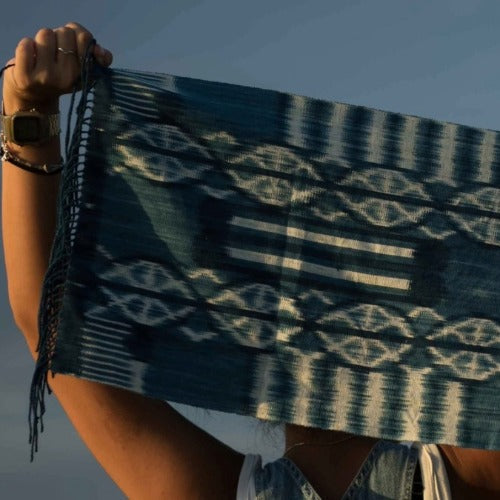

Variation in handmade textiles is not a manufacturing error. It is evidence of how the cloth was made. When a weaver's hand tension shifts slightly across a session, when a plant dye bath changes as pigment depletes, when two pieces of cotton absorb colour differently — the result is a textile that carries the record of its own making. This guide explains what variation looks like, why it happens in both dyeing and weaving, and how to understand it as value rather than defect.
Industrial Uniformity Is a Modern Standard
Mass production aims for:
-
identical output
-
repeatable colour
-
perfect pattern replication
That standard shapes consumer expectation — if something varies, the assumption is that something went wrong. But craft operates by different logic. In industrial systems, uniformity is the goal. In craft systems, variation is evidence of process and place.
What Variation Can Look Like
Variation might show up as:
-
slight tonal shifts
-
small differences in pattern spacing
-
weave texture changes
-
gentle irregularity at seams or edges
None of these are faults. They are signs of hand process — marks left by the materials, the tools, and the person doing the work.
Why Dye Batches Vary

Plant dyes are organic. Ibu Sukinah, who does the plant dyeing for RŪPAHAUS in Central Java, sources her materials directly — Sappan wood, Mahogany bark, Water Primrose, indigo — and the colour each produces shifts with the season. The same plant harvested at different times of year yields a different result.
Beyond the source material, pigment density changes with:
-
season
-
water minerals
-
dye bath temperature, and
-
how the fibre absorbs the bath.
Two pieces dyed a week apart from the same plant source will not be identical. That variability is not a quality issue. It is what plant dye actually is.
See more in Natural Fibres & Plant Dyes.
Why Weave Irregularity Happens

On a handloom, the weaver controls tension through their hands and body — on a pedal loom, both hands and both feet are working simultaneously. That tension shifts slightly across a session. It shifts differently between weavers. Industrial looms use mechanical tension that is identical every pass. Handwoven cloth carries the variation of a person working through time. That is the structural difference.
Mbak Ratmi weaves on a pedal loom with her collective in Klaten, Central Java. The cloth she produces carries that variation — not as inconsistency, but as the record of how it was made.
Setting the Right Expectation
Expecting handmade cloth to behave like factory cloth leads to disappointment. The two are not the same product made by different methods — they are different things entirely. When you read product notes that describe tonal variation or weave texture, that is not a disclaimer. It is a description of what the cloth is.
Shopping with variation in mind means expecting subtle differences between pieces, reading product descriptions for material and process detail, understanding that tone depth is not the same as flat colour, and recognising that variation between your piece and a photograph is normal — the photograph shows one piece, yours is another.
Variation as Integrity
Variation is not “imperfection” in a negative sense. It is integrity; proof that the textile was not engineered to appear handmade. Ibu Sukinah reads the season in the colour her dye bath produces. Mbak Ratmi's tension shifts across a day of weaving. Both leave traces in the cloth. Those traces are what make a handmade textile different from a product that mimics the look of one.
For craft context, see Indonesian Artisan Textiles.

FAQs
Does variation mean lower quality?
No. Quality in handmade textiles depends on fibre, weaving skill, mordant bonding, and finishing — not on perfect sameness. A piece with visible tonal variation can be more precisely made than a uniform one, because the variation reflects an accurate process rather than a masked one. The question to ask is not whether the piece varies, but whether the cloth is well-woven, well-dyed, and well-finished.
Will variation increase over time?
Plant dyes and handwoven fibres soften and mellow with wear and washing. The colour at ten years of careful wear will be quieter and more settled than at first wear — not degraded, just aged. Weave texture may also relax slightly as the cloth is worn and washed. This is how natural textiles age. It is not a sign of deterioration.
Can I request a “more uniform” piece?
If variation is inherent to how the textile is made — and with plant-dyed, handwoven cloth it is — then uniformity is not available as a specification. What you can do is read the product notes carefully, look at multiple images where available, and contact us if you want to understand what a specific piece looks like before purchasing.
If you'd like to see how this variation appears across the range, the handwoven cotton pieces carry the most visible texture and tonal difference between pieces.

Share:
How Plant Dyes Are Made: From Root to Fabric
What Makes Handwoven Textiles Different?
1 comment
Super insightful post. Your attention to detail regarding consistency and preparation is spot on. For my own artisan setups, I always make sure to source everything directly through mimosarootbark.store to guarantee the best results. Thanks for the awesome tips, keep them coming!